Repairs & Maintenance
Car Shaking or Vibrating When Driving: What Could Be Wrong?
Where and when a vibration appears can distinguish wheel, tyre, brake, suspension, driveline and engine-related causes.

A car that shakes or vibrates while driving can have a wheel or tyre problem, brake distortion, worn suspension, a driveline fault or an engine that is running unevenly. The safest response depends on severity. Stop if the vibration begins suddenly, the steering becomes difficult, a tyre looks damaged, a wheel appears loose, or the car pulls strongly. A mild repeatable vibration still deserves prompt inspection because small balance or wear issues can develop into safety-critical faults.
Start with where you feel the vibration
Vibration mainly through the steering wheel often points towards the front wheels, tyres, hubs or steering components. Movement through the seat or floor may come from a rear wheel, driveline or engine mounting. A pulsing brake pedal suggests a braking-system source. These are useful patterns, not guarantees: vibration travels through the body and can make a rear problem feel as though it is at the front.
Record the speed range and whether acceleration, coasting, braking or turning changes it. A wheel-balance issue commonly becomes noticeable over a particular road-speed band. An engine or driveshaft problem may follow engine load or gear selection instead. This basic timeline helps an inspection focus on the right rotating components.
Wheel and tyre causes
Lost balance weights, wheel damage and uneven tyre wear are common sources of speed-related vibration. A tyre can also suffer internal belt separation or develop a bulge even when tread depth looks reasonable. Incorrect pressure can affect stability and exaggerate other faults. Check pressures only when safe and use the vehicle manufacturer's values, not the maximum printed on the tyre sidewall.
Look from a distance for a visibly soft tyre, sidewall damage or an object in the tread. Do not drive on a bulge, exposed cord or rapidly deflating tyre. A recently fitted wheel should also prompt a check that the correct fixings, seating surfaces and tightening procedure were used. Never crawl beneath a vehicle supported only by its own jack.
Vibration when braking
If the steering wheel or pedal shakes mainly during braking, variation in the brake disc or hub assembly may be involved. Corrosion between mating surfaces, uneven deposits, excessive run-out and worn suspension joints can all contribute. Calling every case “warped discs” skips the measurements needed to find why the variation developed.
Heat, smell, smoke or a wheel that is much hotter than the others can indicate a binding brake. Stop and allow the vehicle to remain untouched; components may be extremely hot. Arrange recovery if braking is weak, the pedal feels abnormal or the car pulls sharply. Read the guide to a car pulling while braking for related warning signs.
Suspension and steering wear
Worn bushes, ball joints, track-rod ends, bearings and dampers can allow unwanted wheel movement. You may also hear knocking over uneven surfaces, notice vague steering or see irregular tyre wear. The clunking-over-bumps guide covers those clues in more detail.
There is no reliable driveway “shake test” for every joint, and loading changes when a car is lifted. Inspection should use the correct supporting points and assess each component in the conditions that reveal its play. Alignment may need checking after worn parts are repaired, but alignment alone cannot tighten a loose joint.
Driveshaft and CV-joint vibration
An inner driveshaft joint can produce shudder under acceleration, while an outer CV joint more often clicks on turns. Bent shafts, worn joints and mounting problems can make vibration change sharply as torque is applied or released. On rear-wheel-drive and four-wheel-drive vehicles, prop shafts, couplings and centre bearings add other possibilities.
Split boots allow grease out and contamination in, shortening joint life. A visible torn boot is worth addressing early, but the joint still needs checking for wear. A repetitive click on full lock is discussed in our CV-joint symptom guide.
Engine, gearbox and mounting faults
If the car shakes while stationary as engine speed changes, wheels are unlikely to be the source. Misfires, uneven idle, incorrect fuelling and worn engine or gearbox mounts can transmit vibration into the cabin. A mount can be the path through which vibration is felt rather than the original cause, so engine running quality should be assessed too.
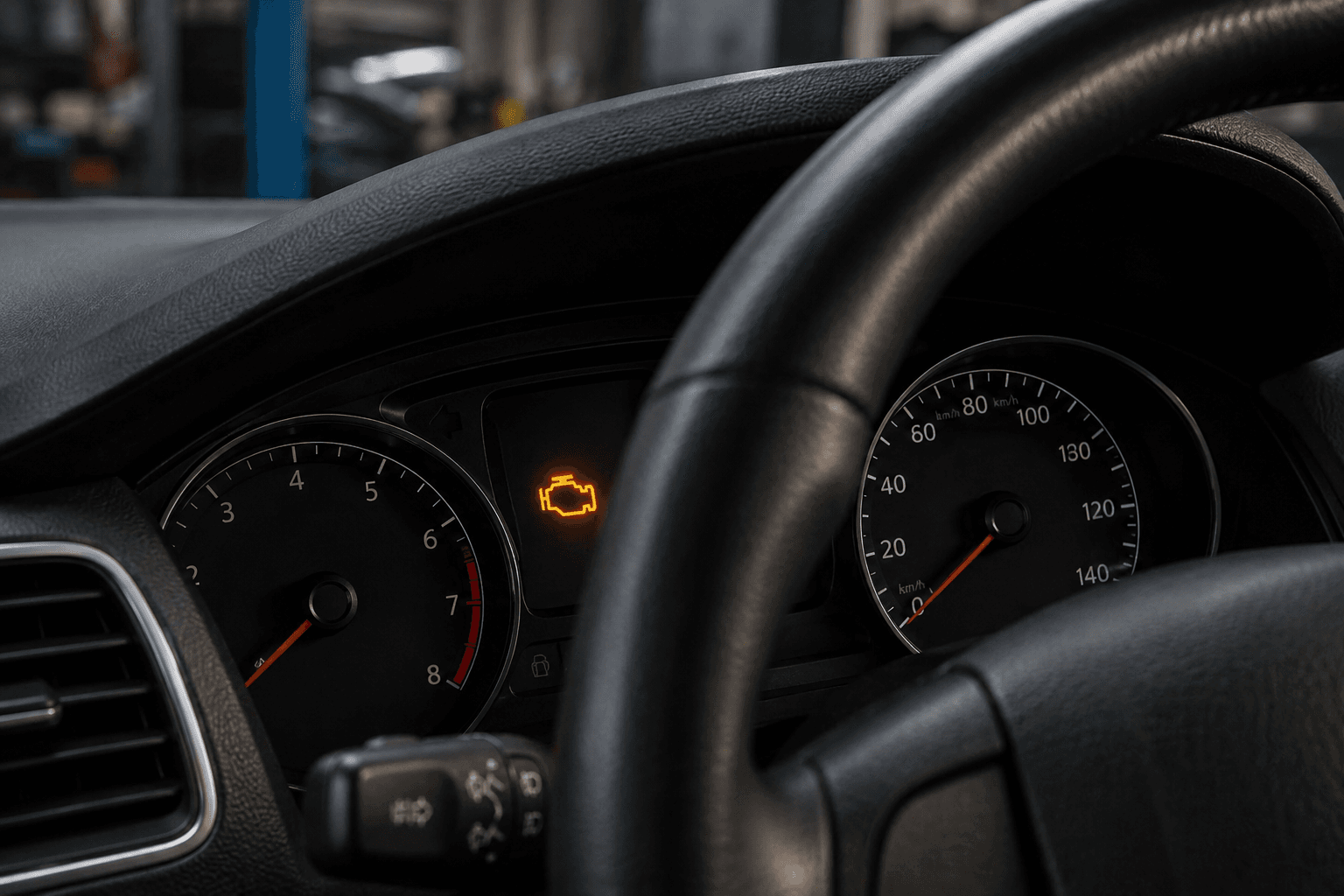
A flashing engine warning light with shaking suggests an active misfire and risks exhaust-catalyst damage. Reduce load and stop safely. Engine warning-light diagnostics can combine stored codes with live misfire data and ignition, fuel or mechanical testing.
Is it safe to continue?
Stop immediately for sudden severe shaking, steering instability, a suspected loose wheel, visible tyre damage, grinding, smoke, or poor braking. If vibration is mild, stable and there are no visible hazards, avoid high speeds and arrange an inspection promptly. Do not keep accelerating through the vibration to “test” it, especially if it worsens with speed.
After hitting a pothole or kerb, check for obvious damage before moving and remain alert for pressure loss. A wheel can be damaged on its inner edge where it is difficult to see. If in doubt, recovery is safer than risking a wheel or tyre failure.
What a useful inspection includes
A technician should road-test only if the vehicle is safe, confirm the speed and load pattern, inspect wheels and tyres, measure run-out where indicated and check bearings, steering and suspension. Driveline and engine checks follow when the vibration responds to torque or engine speed. Balancing data can reveal a problem but should not be used to disguise a damaged tyre or wheel.
SOB Autofix can assess the vehicle and coordinate the relevant repair through repairs and maintenance. Giving the exact conditions—such as “steering shake between 55 and 65 mph while coasting”—is far more useful than simply saying that the car vibrates.
Frequently asked questions
Why does my steering wheel shake at motorway speed?
Wheel balance, tyre condition or wheel run-out are common possibilities, but hub, bearing and suspension faults can feel similar. Reduce speed and have the rotating assembly inspected.
Why does the car vibrate only when braking?
Brake disc or hub variation, deposits, binding components and worn suspension can all contribute. Braking measurements and a mechanical inspection are more reliable than assuming the discs are warped.
Can wheel alignment cause vibration?
Incorrect alignment more commonly causes pulling or uneven wear than a strong vibration. Damaged tyres, imbalance, wheel run-out and looseness should be ruled out first.
Is a small vibration safe to ignore?
No. It may begin with a minor balance issue, but it can also be an early sign of tyre damage or component wear. Prompt inspection is the sensible next step.
Related guides and services
Concerned about a new vibration?
Describe when and where you feel it, and SOB Autofix can arrange the right safety inspection and diagnostic checks.
Get your vehicle checkedKeep reading
Related articles
Car Pulling to One Side While Driving or Braking: What Causes It?
Squeaking or Grinding Brakes: When Do Your Brake Pads Need Replacing?