
Diagnostics
How to Tell Whether Your Car Battery or Alternator Is Faulty
Starting symptoms, warning lights and proper load tests help distinguish a weak battery from a charging-system fault.
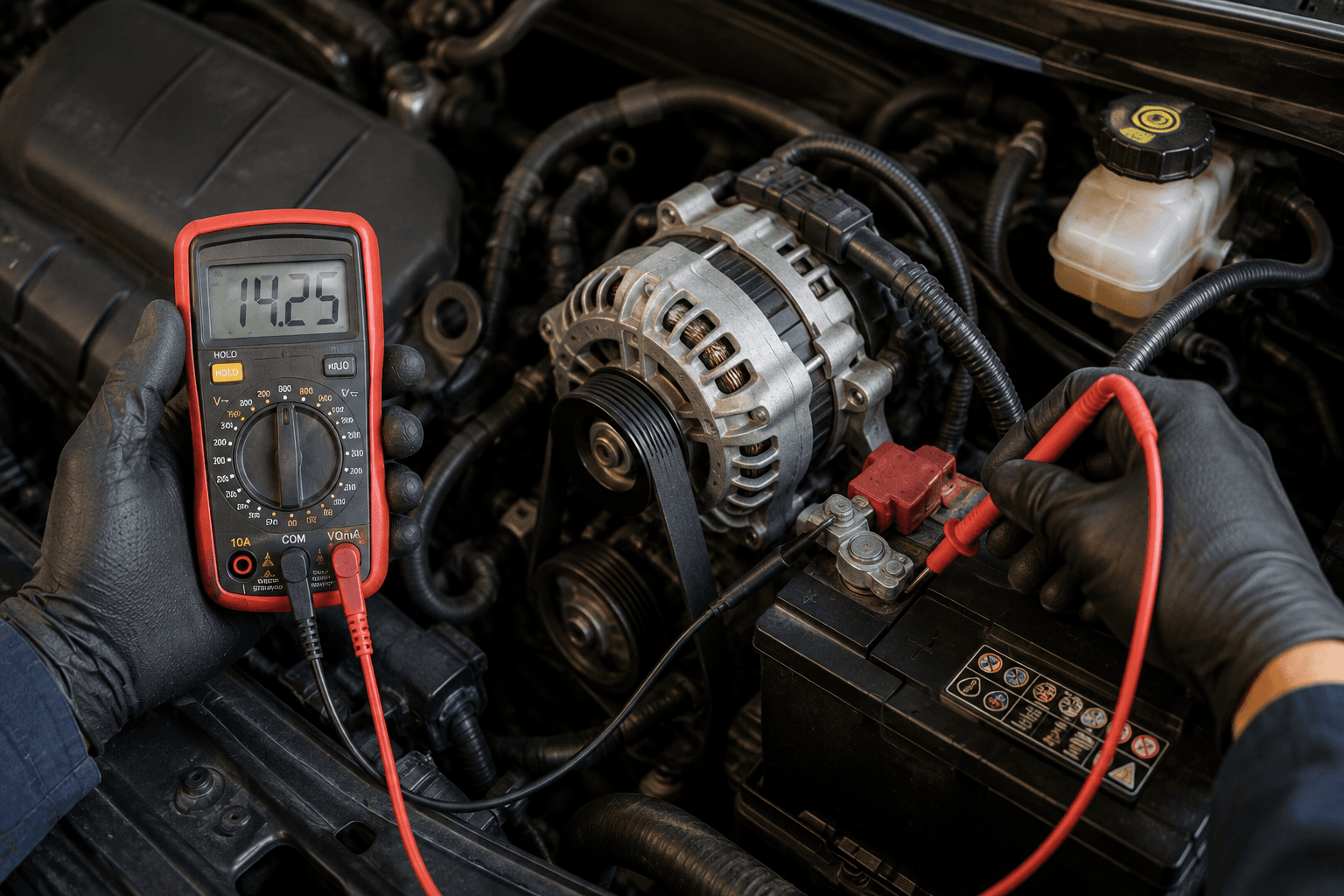
A weak battery most often shows itself when starting: slow cranking, rapid clicking or electrical resets after the car has stood. An alternator or charging fault more often causes the battery warning light while the engine is running, falling brightness, multiple electrical warnings or an engine that stops after a jump start. These patterns overlap, so voltage alone or a successful jump cannot confirm which component is faulty. The battery, charging output, drive belt and cables should be tested as one system.
Signs that point towards the battery
A battery loses capacity with age, repeated deep discharge, heat, cold and long periods undercharged. The starter may turn slowly in the morning, especially after the car has stood or in cold weather. Interior lights can still work because they use far less current than the starter. If a full external charge restores reliable starting and the charging system tests correctly, reduced battery capacity becomes more likely.
Physical swelling, leakage, a cracked case or a strong sulphur smell is unsafe. Do not charge or jump the battery; keep sparks away and arrange professional handling. Corroded or loose terminals can imitate a bad battery and must be corrected before its condition is judged.
Signs that point towards the alternator or charging circuit
A warning light that appears during driving, electrical functions weakening with the engine running, or repeated stalling after a boost points towards inadequate charging. Noise from the belt or pulley area, a burning smell or intermittent charging as engine speed changes are other clues. However, cable resistance, fuses and computer control can create the same effect as an internally failed alternator.
Modern charging systems deliberately vary voltage to manage fuel use and battery condition. A quick reading that seems low by older standards may be normal at that instant. Diagnosis should examine commanded charge, current flow and battery state using information appropriate to the vehicle.
Why a multimeter reading is not enough
Open-circuit battery voltage indicates state of charge more than capacity. A tired battery may show a respectable voltage without load and collapse during cranking. Equally, measuring charging voltage with a depleted or defective battery can make alternator behaviour difficult to interpret.
A complete assessment can include battery conductance or load testing, cranking voltage, alternator voltage and current under controlled loads, AC ripple and voltage drop across positive and earth cables. Belt condition and tension also matter. Results need to be compared with manufacturer specifications and temperature.
The cable and earth problem in the middle
The alternator can generate correctly while resistance in a cable prevents energy reaching the battery. Likewise, a good battery cannot operate the starter through a poor engine earth. Terminals may look clean outside while corrosion hides inside a crimp or connection.
Voltage-drop testing measures the loss while current flows and can expose this hidden resistance. Replacing either major component before checking the circuit can leave the original no-start or warning light unchanged.
What repeated flat batteries mean
A battery that is flat every morning may be discharged by a light, module, accessory or wiring fault while parked. It may also be failing internally or never receiving enough charge during short journeys. This is different from an obvious warning light during driving, though the problems can coexist.
Read the guide to a battery that goes flat overnight before assuming an alternator. Parasitic-drain testing requires the car to enter sleep mode and the current to be monitored without waking modules accidentally.
Can you test by disconnecting the battery?
Never disconnect a battery lead with the engine running. Older advice suggested that an engine continuing to run proved the alternator worked, but the resulting voltage surge can damage modern electronics and the test says little about output quality. Use proper measurement instead.
Be cautious with plug-in voltmeters and dashboard voltage displays. They can reveal trends but may read at a different point in the circuit and lack the load context needed for diagnosis.
Jump-start results can mislead
If the car starts with a jump, that confirms the original supply could not start it at that moment. It does not prove the battery itself is the cause. Poor terminals, an overnight drain or inadequate charging may have left it discharged. If the engine stops soon after the jump and the battery light remains on, charging failure is more likely.
Follow the vehicle handbook because hybrids, stop-start cars and vehicles with batteries in remote locations may specify dedicated connection points. Stop for heat, swelling, leakage or reversed polarity.
When not to keep driving
A battery fault noticed only at starting may leave the car running normally once started, but it can fail again at the next stop. A charging warning during driving is more urgent because the vehicle is consuming a finite reserve. Head to safety and avoid restarting unnecessarily. Stop immediately for overheating, heavy steering, burning smells or belt noise.
Our battery-warning-light guide gives a practical on-road response. Do not rely on an estimated number of miles because battery state and electrical demand are unknown.
Getting an evidence-based answer
SOB Autofix provides battery and charging diagnostics and electrical fault finding in Doncaster. Testing can identify whether the battery lacks capacity, the alternator cannot meet demand, control signals are incorrect, or voltage is being lost in the circuit.
If replacement is needed, the correct battery technology and rating matter, especially for stop-start vehicles. Some cars also require battery registration so the energy-management system can adapt its charging strategy. After repair, starting and loaded charging should be verified rather than relying on the warning light alone.
Frequently asked questions
Will a car run with a bad alternator?
It may run briefly from battery energy, but voltage will fall and the engine can stop. How long varies too much to treat as a safe distance.
Does slow cranking always mean the battery is bad?
No. A discharged battery, poor terminals, cable resistance or a dragging starter can all slow cranking. Load and voltage-drop tests separate them.
Can a new battery fail because of the alternator?
Persistent undercharging or overcharging can shorten battery life. Charging-system verification protects the replacement and checks that the original cause is resolved.
What voltage should my alternator produce?
The correct value depends on vehicle strategy, temperature, load and battery state. Modern controlled systems cannot always be judged by one universal voltage figure.
Related guides and services
Battery, alternator or connection?
Test the complete starting and charging circuit so the evidence identifies the cause before a component is replaced.
Book battery diagnosticsKeep reading
Related articles

Car Electrical Problems: 10 Signs You Should Get Your Vehicle Diagnosed